Cultural organizations at their best: The secret to the Filipino Student Association’s energetic community
A conversation with the president of FSA about the success behind the three time UTMSU Cultural Club of the Year.
Listen to the audio version of this article here!*
The Filipino Student Association (FSA) has been in operation for the last decade and has stood the test of time. At its core, FSA aims to “provide a space for Filipinos and those interested in Filipino culture” through events that “foster greater appreciation and awareness for Filipino culture” and “represent the Filipino community at large here at UTM,” according to their constitution.
To explore the secrets behind FSA’s longevity and accolades, The Medium spoke with FSA President Marie Bueno, a fourth-year international student in management and economics.
Bueno shared that the FSA was established because Filipino students used to “hang out” largely with the Chinese and Vietnamese communities on campus and eventually “needed a space of their own [to] connect with their culture.”
Bueno first encountered FSA in her second year. “I spoke with some of the VPs and the president at the time during [the club’s] tabling,” she recounted. “They told me about the kind of events that they host.”
As Bueno became more involved, she focused on helping to build a community that provides “meaningful opportunities and networking” alongside friendships and professional development.
FSA’s annual mentorship program specifically functions to facilitate the transition into UTM life. Last year’s “Lakbay Mentorship Program” involved students split into two groups, panganays (upper-year mentors) and bunsos (lower-year mentees), brought together through “rotating group sessions” as opposed to the standard one-on-one mentorship.
The club does not shy away from connecting with the wider community of UTM students. “We consistently welcome students from different nationalities and ethnicities,” Bueno explained.
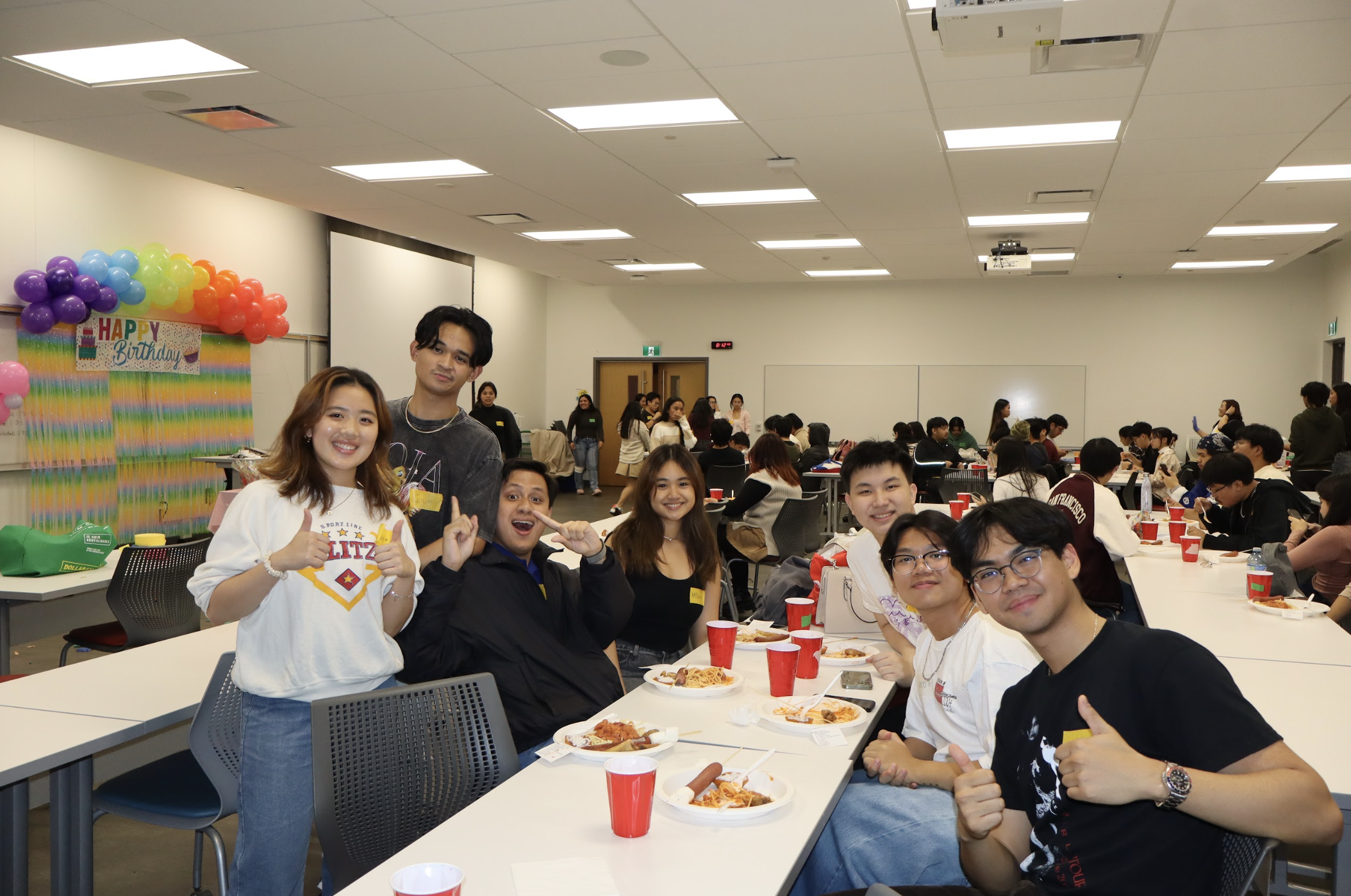
“Every time we promote an event, we make it clear that everyone is welcome here and you can bring any friends that you have. We offer free food, and our games and events are a lot of fun.” FSA’s events are also intended to be an opening for cultural exchange, so much so that the club has an unspoken rule that no Filipino or Tagalog is spoken during them.
Collaborations are the key to FSA’s success. “FSA has never operated entirely on its own,” said Bueno. “Every single year, we have at least three collaborations. We’ve built relationships with other campus groups at UTM, as well as Filipino student associations at other universities, community organizations and food partners who work with us every single year and sponsor us.”
She explained the FSA has fostered relationships that opened up opportunities for the club to reach more people and organize experiences that wouldn’t have been possible if done independently.
The club’s most ambitious collaborations involve Filipino student associations across the GTA and southern Ontario. One notable example is their annual gala. Last year’s gala, “Flores de Mayo: A Night in Bloom,” was hosted at Hart House in May, alongside the Filipino Students’ Association of Toronto, the Filipino Student Association of Scarborough, and the Filipino Students’ Association at York.
Bueno explained that the gala celebrated “the beauty of Filipino culture where heritage blossoms and community gathers,” while assuring that “everyone gets their reyna (queen) moment.”
According to Bueno, a Filipino gala consists of a lot of music, band performances, singing, and partying. “One thing about FSA,” she said, “is that we’re not the music club, but we’re always down to perform.” Another event that stood out to her was the Binibining Sustainabelle with the Filipino McMaster Student Association.
Meanwhile, collaborations with UTM groups are driven by Bueno’s belief that “cultural organizations are at their best when we really celebrate our own identity, but also invite other people to experience it.” She listed a handful of collaborators from the UTM Art Club, the UTM Film Club, and the UTM Vietnamese Student Association.
“Especially at UTM, where the community is so diverse, it’s really awesome to see different clubs collaborate,” Bueno said. “It’s really fun to make new events every year and build new things with people of other cultures as well.”
The effectiveness of FSA’s operations can be attributed in part to the club’s internal structure. As far back as 2020, FSA’s management has consisted of teams focused on communications, finance, internal operations, external operations, engagement (presidential duties), and events (added in 2023-24.)
“We really aim to improve in every department and aspect of FSA,” Bueno explained. Her goals include more engagement and outreach from the communication team as well as looking for more partners and sponsors from the external team—which have already been attained. The president also looks toward the internal team to help the executive team bond and work in a “psychologically safe environment.”
Bueno ascribes the club’s success to her executives’ ability to innovate while maintaining tradition. “We try to preserve events that students generally look forward to in the year,” she said. “But also introduce new initiatives that reflect what our current members want and what seems appealing at the time.” Their commitment to this is evidenced by FSA’s previous gala, advertised as “Rooted in tradition and reimagined for today.”
Collaboration and innovative event planning are two factors of the FSA’s success that also go hand in hand. Bueno said, “By having collaborations, more brains are thinking about what to bring, which means more food and more options, more people working behind the scenes and also celebrating more than just one culture.” She described the events as “a bunch of people coming together to have fun, play games, eat and have meaningful and productive conversations.”
The FSA is currently working on a membership card that would offer members discounts at their seven partner businesses. They also want to introduce more career-focused programs, one being “Networking Night,” a tri-campus Filipino student association collaboration, where they will “connect students with more than 30 alumni and professionals who can share their experiences and help students navigate their career.” An unnamed Filipino street food event is also in the works. It intends to recreate the food market atmosphere from the Philippines at UTM.
Bueno concluded, “This year I want us to be more intentional about our programming. Students should be able to come to FSA to have fun, but also leave with new friendships and professional connections.”
*AI-Generated Audio Transcription Disclaimer
The audio transcription included in this article was generated using artificial intelligence (AI) technology with the purpose of improving accessibility for our readers and providing an alternative opportunity to engage with The Medium‘s content. Please note that AI-generated transcriptions may contain errors or inaccuracies in pronunciation, wording, or interpretation.
The original written article remains the authoritative version of the content. If you notice an error in the audio transcription, please contact social@themedium.ca so we can conduct further reviews and corrections.