Chaotic and Unruly? A look at Meet Me at Ridgeway, a documentary about culture, third spaces, and Mississauga politics.
The documentary explores how Mississauga’s Ridgeway Plaza has grown into a cultural hub while raising questions about community representation and municipal politics.
Listen to the audio version of this article here!*
In the spring of 2022, Ridgeway Plaza, as part of the Erin Mills commercial centre project, transformed from a space initially advertised strictly for retail into what is now considered North America’s largest halal food market.
Comprising 277 pharmacies, grocery stores, and restaurants, Ridgeway is a cultural hub for residents of Mississauga and neighbouring communities. Its diverse range of cuisines, predominantly Middle Eastern and South Asian, bring culture and community together into one melting pot of identity.
Its popularity among students, especially those at UTM, is partly due to its location at Eglinton Avenue and Ridgeway Drive, accessible from campus by the 44 and 35 buses. With a variety of barbecue, home-style food, desserts, and cafés, Ridgeway offers a “third place” where students can find familiarity and comfort with friends and family after class.
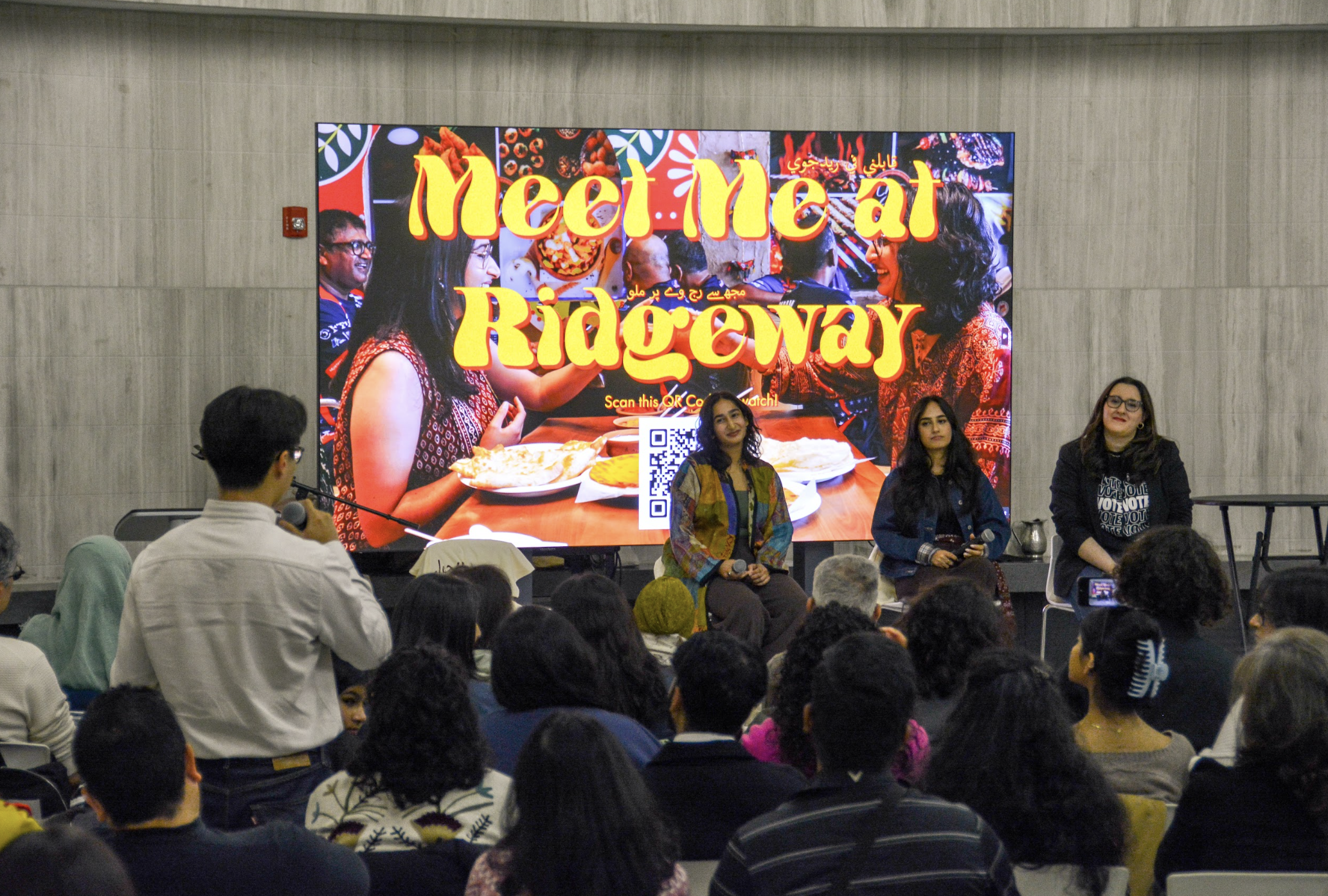
A mainstay of local culture, the plaza features heavily as the main subject of Meet Me at Ridgeway, a ten-minute documentary which premiered at the Kaneff Centre on October 6. Created and edited over two months, brought together a team, including sisters Laila and Marium Vahed, U of T alumni who directed and wrote the film, alongside UTM alumna and producer Nicole Danesi and Mahmoud Sarouji, editor and director of photography, among others.
The Vahed sisters facilitated the documentary. They visited two popular Ridgeway establishments, Cha Sha and Sumaq Iraqi Charcoal Grill, to try their specialties and interview the owners about their businesses and the broader plaza.
At Cha Sha, owner Tahir Mehmood served the sisters the popular “Nashta Channa,” a breakfast chickpea dish accompanied by a variety of side dishes. Having migrated from Pakistan more than 28 years ago, Mehmood described a gap in which food had “failed to touch my soul.” Through his reimagined vision, Cha Sha became a family business that celebrates Pakistani heritage while also welcoming guests from other cultures.
At Sumaq, co-owner Hamzah Al-Ameri discussed how businesses in Ridgeway look out for one another when suspicious or chaotic activity occurs. He also challenged the assumptions often generalized about the plaza, emphasizing its intentions as a “family gathering.” He described it as “somewhere safe to come” and “where [people] can enjoy good food.”
Following the screening, a moderated Q&A segment featured L. Vahed, Danesi and researcher Zoha Ahsan. They discussed their intentions for the film, as well as the elements of research, interviewing, and editing that went into it.
L. Vahed explained that the film aimed to spread joy about the often controversial plaza. “We wanted to hint at this story of Ridgeway, to talk about and explore that intersectionality of our everyday lives, that we live and breathe,” she said, highlighting how “culture sits at the very heart of social change and transformation.”
Danesi added that the documentary intended to spark interest in the upcoming municipal election, given Mississauga’s low voter turnout over the years. In the 2022 municipal election, 21.84 per cent of residents voted; it rose to approximately 25.7 per cent in the 2024 by-election, according to CBC News.
Danesi explained that encouraging people to care about politics meant “leaning into the plaza’s storytelling potential.” By starting with something people already care about, the film could highlight how city council decisions affect Ridgeway and its policies.
Beyond celebrating Ridgeway’s cultural significance, the film also challenges negative perceptions of its bustling atmosphere and often chaotic parking lots. Controversies surrounding traffic congestion and large gatherings have prompted public complaints and city council discussions.
In response, the City of Mississauga introduced measures to monitor disruptive behaviour, including police presence at road intersections and bylaws regulating certain celebrations.
In 2025, celebrations for Pakistan Independence Day and Afghanistan Independence Day were subject to injunction orders intended to prevent large-scale gatherings at the plaza. The nuisance gathering enforcement bylaw directed local officers to monitor activity at Ridgeway in the interest of “public safety and order.”
Such restrictions raise questions about how cultural celebrations are managed and how racialized communities are perceived. Ahsan argued that the public discourse surrounding Ridgeway has often crossed the line from criticism of the built environment to prejudice against the people who use it.
“A lot of the coverage and a lot of the public discourse around Ridgeway was quite frankly very racist,” Ahsan explained. She recalled that even her own family mocked her thesis topic on Ridgeway as a third space for immigrants, suggesting she choose “anywhere but Ridgeway” because the racialized minorities there “make us look bad.”
After the panel, I spoke with Danesi and Sarouji, both former reporters from The Medium, about their experiences making the documentary. Danesi shared that she met Sarouji more than ten years ago while working at the newspaper.
When Danesi approached Sarouji about the project two months ago, he was immediately on board. Having not worked together in years, Danesi found Sarouji’s readiness to take on the project endearing, particularly given his career since UTM. “For that sort of trust and enthusiasm to jump at something like this was really meaningful,” she said.
As a producer and writer, Danesi explained that one of the biggest challenges was showing how everyday life connects to municipal government. There was only so much the documentary could explore in its nine-minute time frame. Danesi hopes to eventually develop it into a feature film, while using the documentary to spark conversations within Ridgeway itself.
“We really want to use this as an artifact to spark that conversation,” she said, encouraging residents to reflect on their involvement in the community and their roles as active citizens.
Sarouji also reflected on the importance of bringing people together for the screening. “We all have our small villages,” he explained, describing how the event demonstrated what can happen when different communities come together to support one another.
Working closely on the documentary also deepened Sarouji’s personal connection to Ridgeway. Although he already knew the food was incredible, seeing it behind the scenes gave him a greater appreciation for its uniqueness. “I love being this close to it and being able to tell that story,” he shared.
Ultimately, Ridgeway represents inclusivity and the importance of preserving shared spaces where people from different backgrounds can cultivate authentic connections. Sarouji concluded that showing up for a community is what helps create a place like Ridgeway. “Ridgeway isn’t just the plaza; it is more than that; it is the third space.”
He said that Mississauga is “not just a suburb of Toronto anymore; it is its own city, and it has its own place.” For Sarouji, Ridgeway is “beautiful and wonderful.” He added, “Honestly, it’s for everybody.”
*AI-Generated Audio Transcription Disclaimer
The audio transcription included in this article was generated using artificial intelligence (AI) technology with the purpose of improving accessibility for our readers and providing an alternative opportunity to engage with The Medium‘s content. Please note that AI-generated transcriptions may contain errors or inaccuracies in pronunciation, wording, or interpretation.
The original written article remains the authoritative version of the content. If you notice an error in the audio transcription, please contact social@themedium.ca so we can conduct further reviews and corrections.