
UTMSU Fall By-Elections draw 182 ballots from about 16,450 eligible members
Newly elected first-year representative Usayd Ansari kicks off his tenure by planning a public feedback form and advocating for earlier campus food access during Ramadan.
Listen to the audio version of this article here!*
The UTMSU announced the results of its 2026 Fall By-Elections in an Instagram post on October 23. A total of 182 ballots were cast out of approximately 16,450 eligible voters according to UTMSU President Adam El-Falou.
Last year, 264 ballots were cast out of approximately 3,000 eligible members, when voting for Division I was restricted to first-year students. This year, the eligible electorate increased to approximately 16,450 members, representing all UTM undergraduate students.
Based on the figures provided by El-Falou, voter participation represented approximately 1.1 per cent of eligible members, compared to 8.8 per cent last year.
The election’s low turnout raises questions about how the UTMSU can encourage more students to participate in student governance.
The by-elections filled four positions on the UTMSU’s board of directors: two first-year representatives, one part-time director-at-large, and one professional faculties representative.
First-year seats
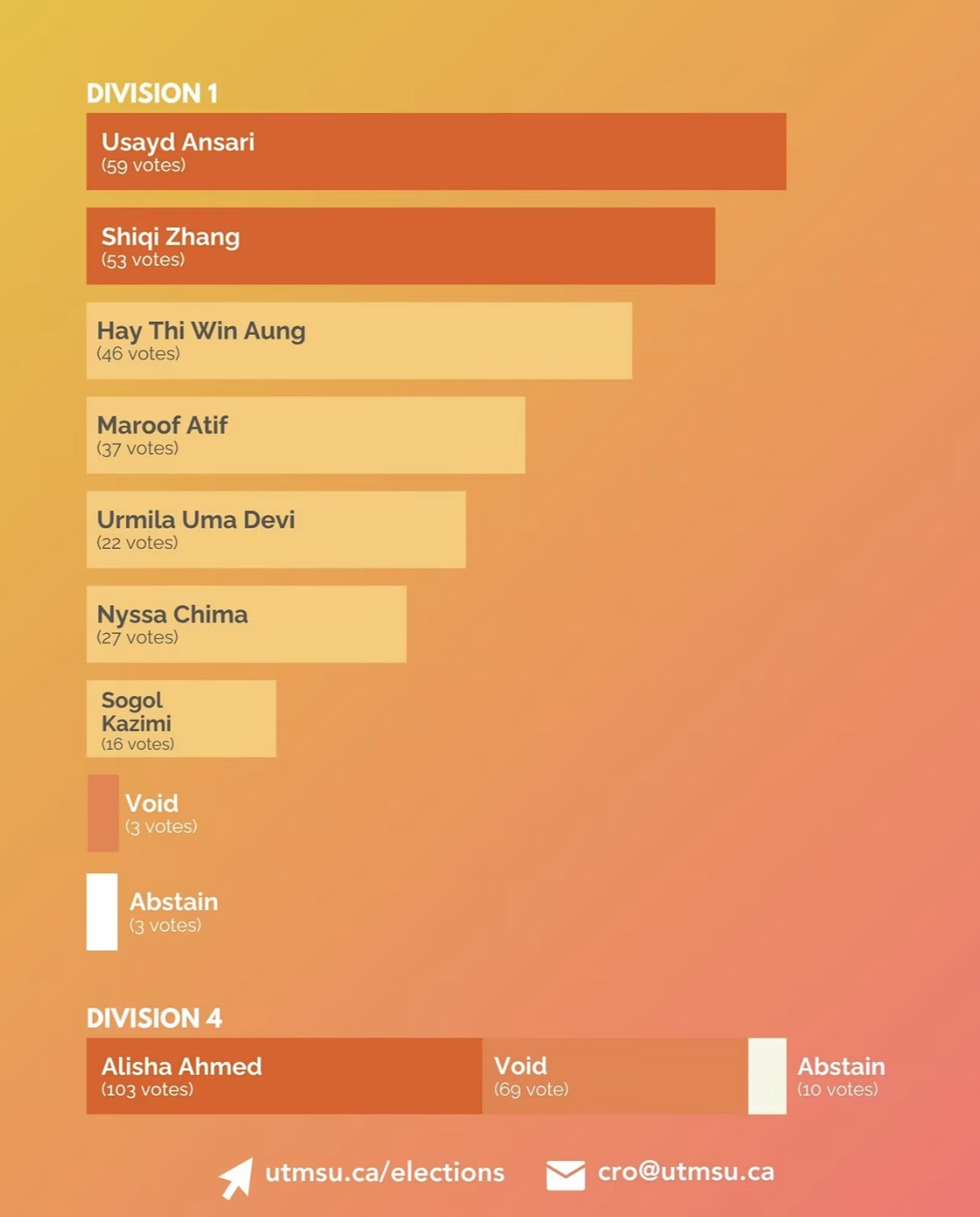
Division I, representing first-year students, attracted eight nomination packages. One candidate withdrew before ballots were printed, leaving seven candidates competing for two seats.
In an email interview with The Medium, Usayd Ansari, who received the highest number of votes in Division I, said his student government experience motivated him to run for the position.
“Apart from a few stints in middle school, I was student representative in my last two years of high school, and I love interacting with my community!” Ansari wrote.
Despite his previous experience, Ansari admitted that the election results came as a surprise.
“The election results were…honestly EXTREMELY surprising,” he wrote. “There were a few candidates who definitely had stronger campaigns, but I think my network and reach really helped with gathering the votes needed to secure the election!” He expressed hope to see the other candidates run in the Division II election in spring 2027.
Drawing from his experience living in residence, Ansari said that students sometimes find existing community gatherings and workshops boring. He suggested that events organized by students, if affiliated with the UTMSU, could draw larger crowds, and pointed to the Student Centre debut as a success he wants to emulate on a smaller scale.
Ansari also brought up food access during Ramadan. Muslims who observe the fast must finish eating before dawn. However, Ansari said that Colman Commons and other campus food services do not open early enough. Colman Commons’ regular academic-year hours begin at 7:30 a.m.
To address this issue, Ansari said he has started helping to arrange access to food on campus earlier in the day. Ansari also plans to post a public feedback form through his social media platforms aimed at first-year students to submit questions, concerns, and suggestions for consideration at UTMSU meetings.
He added that he periodically speaks with fellow students in residence to identify concerns that fall within the UTMSU’s purview.
Professional faculty seats
Unlike Division I, which saw seven candidates competing for two positions, Division IV’s professional faculty representative position had only one candidate.
Alisha Ahmed was confirmed to the position after receiving 103 votes, alongside 69 void ballots and 10 abstentions.
El-Falou explained that the difference in the number of candidates reflects how the two divisions select their representatives.
“The first-year representative positions are open to the full first-year student body, so it is natural for several students to put their names forward in a competitive election,” he wrote.
The Medium also asked El-Falou about the high number of void ballots recorded in Division IV.
“A spoiled/void ballot generally means it could not be counted. For example, because it was improperly marked or ruled ineligible or if a voter is later found not eligible to vote,” El-Falou explained.
For Division IV, the U of T Medical Society appoints a representative to run for the position on the UTMSU board. As a result, the position is generally filled through this representative process rather than attracting multiple independent candidates.
With only one candidate, Division IV proceeds through a confirmation vote, allowing eligible students to vote in favour, against, or abstain.
El-Falou said that the UTMSU maintains close ties with the U of T Medical Society to ensure professional faculties students continue to have representation on the board.
The union was unable to provide a verified figure for the total number of professional faculties students represented by the position.
Looking ahead
The newly elected representatives will take on the responsibility of bringing student concerns to the UTMSU board of directors.
For Ansari, that means creating more opportunities for students to connect while establishing ways for first-year students to communicate their concerns directly.
*AI-Generated Audio Transcription Disclaimer
The audio transcription included in this article was generated using artificial intelligence (AI) technology with the purpose of improving accessibility for our readers and providing an alternative opportunity to engage with The Medium‘s content. Please note that AI-generated transcriptions may contain errors or inaccuracies in pronunciation, wording, or interpretation.
The original written article remains the authoritative version of the content. If you notice an error in the audio transcription, please contact social@themedium.ca so we can conduct further reviews and corrections.