
The University of Tkarón:to : We learn on the banks of the Missinnihe
Peering into the history of those who walked before us.
Listen to the audio version of this article here!*
I (we) wish to acknowledge this land on which the University of Toronto operates. For thousands of years it has been the traditional land of the Huron-Wendat, the Seneca, and the Mississaugas of the Credit. Today, this meeting place is still the home to many Indigenous people from across Turtle Island and we are grateful to have the opportunity to work on this land. – UTM Land Acknowledgement
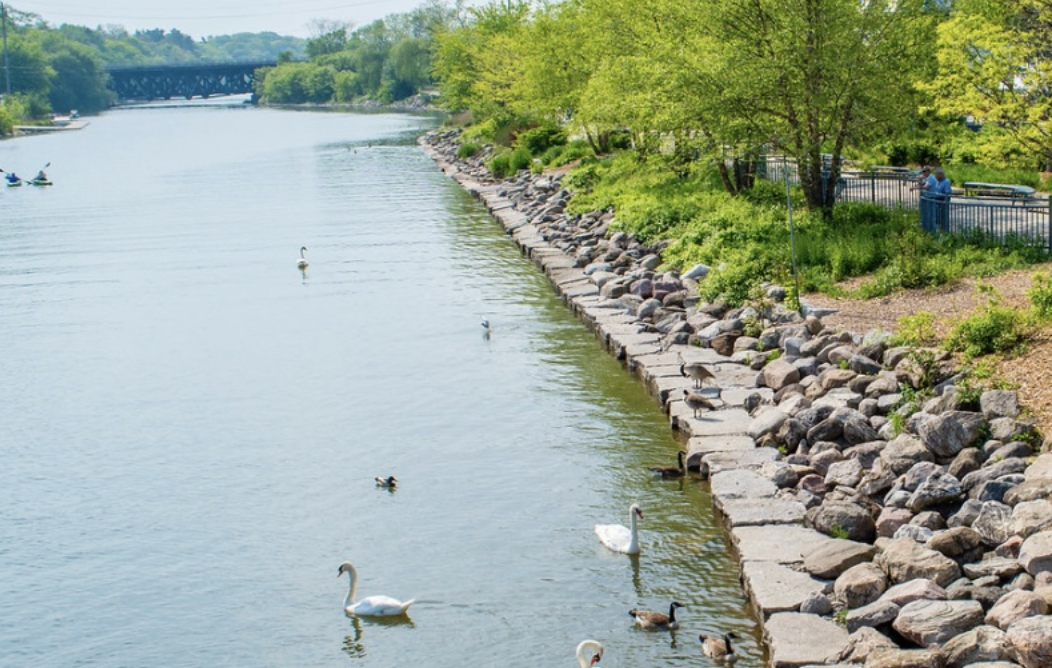
Every presentation and every event starts with these lines. A reminder that UTM used to belong to someone else—and they are still connected. The paths we walk from one class to the next were walked by Indigenous tribes for centuries. The river we look at from the bus stop could have been a centre for trade and business just 300 years ago.
Many of their traces have vanished, poured over by concrete and Westernization. But, the presence of our predecessors still remains. The name Toronto, for example, is derived from the Haudenosaunee word Tkarón:to, which literally translates to “where there are trees standing in the water.” In a Global News report, Indigenous Elder Duke Redbird further interpreted Tkarón:to to mean “meeting place,” as the original word referred to fishing weirs where First Nations people would gather.
Another trace lies in the name Missauaga. The Mississaugas of the Credit First Nation (MCFN) explain that our city’s name is the European term for their nation: either coming from the word Minzazaheeg (people living where there are mouths of many rivers) or from the word Masasagi (eagle).
The etymology raises certain questions: why was Toronto instead Tkarón:to for our predecessors? And who were the Minzazaheeg, the last predominant Indigenous group to control Mississauga? Let us trace back the footprints of our forebearers, back to 1200 AD.
The Three Toronto First Nations
In Indigenous Peoples in Toronto: An Introduction for Newcomers (IPT), published by the city of Toronto, the authors explain that every Indigenous tribe/clan/group is unique, with its “own history, culture, and worldview.” Many First Nations are part of large alliances based on similarities in culture, language, and shared history.
Toronto is the traditional home to three predominant nations: the Huron-Wendat, the Haudenosaunee, and the Anishinaabe. You will recognize the Huron-Wendat from our land acknowledgement. Between 1200 and 1600 AD, the Huron-Wendat had permanent villages on the northern shore of Lake Ontario—the region we called Toronto.
Tkarón:to: The Early Indigenous Trading Hub
The reason why these nations chose to reside in the region was because what is now Toronto was an extremely important trade region for Indigenous communities. In a panel discussion at the Museum of Toronto, indigenous artist Bonny Devine explains that the Toronto region was the perfect trading area.
In the University of Calgary’s Where Histories Meet, Kory Snache of the Chippewas of Rama explains how Lake Ontario was “a natural chokepoint,” as travellers had to pass the lake to go anywhere inland within Ontario. Similarly, Lake Ontario also offered a shortcut into the upper Great Lakes, including Lake Superior, Lake Michigan, and Lake Huron, connecting Indigenous communities in the region.
Andrew Big Canoe of the Chippewas of Georgina Island shares that Indigenous travellers “used to travel back and forth on all those rivers…. If they went to visit anybody, they’d take the rivers.” As the UTM land acknowledgment states, this land really was a meeting place for Indigenous communities across Turtle Island—otherwise known as North America
Devine explored Toronto’s past as an Indigenous trade zone through archaeological finds in the region: dig material like turquoise, copper, and shells used for Wampum belts (important contracts and documentation for Indigenous tribes) not native to the area. In addition, the peoples of the Huron-Wendat were known for growing corn, beans, and squash—crops that originated from Mesoamerica, which travelled up riverways and paths to eventually reach Toronto.
The Huron-Wendat made good use of these trade networks, as they were particularly notable for their durable and light canoes.
The Advent of the Haudenosaunee and Anishinaabe
By the 1600s, control of the area started to change as French fur traders started to build trading forts around Lake Ontario, according to Indigenous Peoples in Toronto. The French brought with them diseases that weakened the Huron-Wendat.
By the 1630s and 1640s, the confederacy had lost approximately 45% of its population. The weakened Huron-Wendat were then attacked by the Haudenosaunee Confederacy, catalyzing their fall. The remnants of the Huron-Wendat relocated to other areas of what is now Ontario, Québec and the United States.
In the mid-1600s, the Haudenosaunee started establishing their own permanent settlements near present-day Toronto. Most notably, the Seneca, a nation within the Haudenosaunee, established two villages in the area—hence their mention in our land acknowledgement.
However, this did not last long. Three Anshinaabe nations, the Ojibwe, Odawa, and Potawatomi nations, formed the Three Fires Confederacy and fought to push back the Haudenosaunee from Toronto. Their efforts were successful, and by the end, the Mississaugas permanently settled into the region.
The Minzazaheeg
The MCFN website explains that the Mississaugas are a sub-group of the Ojibwe. The MCFN’s oral tradition states that they played a key role in pushing back the Haudenosaunee, and settled permanently in the region by 1695.
The Mississaugas were seasonally migrant: shifting locations depending on the resources available. During wintertime, they spread out across their territory in smaller groups of family members, feeding themselves through hunting and icefishing.
In early spring, families moved towards the sugar bushes to tap the maple trees. Afterwards, they congregated on the Missinnihe, which translates to “trusting creek,” to fish salmon. Darin Wynbega, a member of the Mississaugas of the Credit First Nation and the community’s Traditional Knowledge and Land Use Coordinator, shared in a webinar with Massey College that the Missinnihe was the principal home of the Mississaugas.
From spring until fall, the Mississaugas followed a more sedentary lifestyle along the Missinnihe. Along the banks, they planted crops and started their preparations for the winter. Wynbega also mentioned that this period was “a great time of socialization for the people, further explaining that the Missisagaus met there “to fish, … to reacquaint ourselves with each other [after winter], find spouses, to engage in ceremony, and to engage in games.”
Until the late 1700s, the Mississaugas were able to follow this lifestyle while keeping peace with other First Nations and European colonists.
The Dish with One Spoon
Shortly after the Mississaugas settled in Toronto, the APTN News explains that a long sequence of wars between Haudenosaunee and Anishinaabe nations were brought to a conclusion with The Great Peace of Montreal, when a peace treaty was signed between the French, Haudenosaunee and Anishinaabe in 1701.
A crucial component of this treaty was the concept of “a dish with one spoon.” Richard Hill, a Haudenosaunee historian, breaks down the metaphor in a Historica Canada video series. The dish represents the land and everything in it; everyone must share what’s in the dish with the same spoon, and everyone gets an equal share and equal opportunity to take from the dish. At the same time, everyone must follow the base rules to make sure the dish isn’t polluted, and so that everyone can enjoy the bounty.
Following the treaty, the Mississaugas had an amicable relationship with French Traders. During the spring-fall period, the Mississaugas would also trade with the French, who set up an outpost very near the Missinnihe. The French traders were in the habit of extending credit towards the Mississaugas. Wynbega shared that it was this practice that led to the Missinnihe becoming known as the Credit River—the river right outside our UTM campus—and the Mississaugas becoming known as the Credit River Indians, or Mississaugas of the Credit.
While the amicable relationships with outside communities were maintained for some time, the growing Euro-Canadian settlement put increasing pressure on the Mississaugas’ way of life. As a result, they agreed to “surrender” the land to the British colonial government through a series of land treaties.
However, the MCFN explains that the validity of said surrenders are questionable, as both parties had very different views on the topic. The British believed they were paying for the land, and they had sole ownership. However, the Mississaugas viewed the agreements as a way to share the land with the British, similar to the “dish with one spoon,” and that the payment was the beginning of an amicable relationship rather than a closed transaction. The Mississaugas never surrendered their right to roam the lands freely, and were confused by the British prohibiting them to do so.
While the Mississaugas gained some exclusive fishing rights, over time their dwindling population due to disease forced them to relocate to a reserve.
Eternal Stewards
It’s easy to think that the Indigenous people were ousted by the European colonists and paint this story in the familiar light of colonialism ruining everything. However, as Wynbega says in Waterfront BIA’s Missisakis: An Indigenous History of the Tkaronto Islands, “we’ve never left those lands; we’re still on the land we occupied 1700 years ago.”
Even today, the Mississaugas of the Credit are still stewards of this land. Their life is different from what it was a few centuries ago, but their role and connection has not changed. Our predecessors’ footprints are not a memory that we walk over; rather, we are both leaving footprints here, walking side by side.
*AI-Generated Audio Transcription Disclaimer
The audio transcription included in this article was generated using artificial intelligence (AI) technology with the purpose of improving accessibility for our readers and providing an alternative opportunity to engage with The Medium‘s content. Please note that AI-generated transcriptions may contain errors or inaccuracies in pronunciation, wording, or interpretation.
The original written article remains the authoritative version of the content. If you notice an error in the audio transcription, please contact social@themedium.ca so we can conduct further reviews and corrections.

Features Editor (Volume 51); Associate Features Editor (Volume 50) — Madhav is a third year student completing a double major in mathematics and computer science, and a minor in professional writing. Everyone in UTM has a unique story that makes them special and deserves to be told. As the Features Editor, Madhav wants to narrate these types of stories with creative and descriptive writing. In his off-time, Madhav loves watching anime, reading manga or fantasy novels and listening to music.