
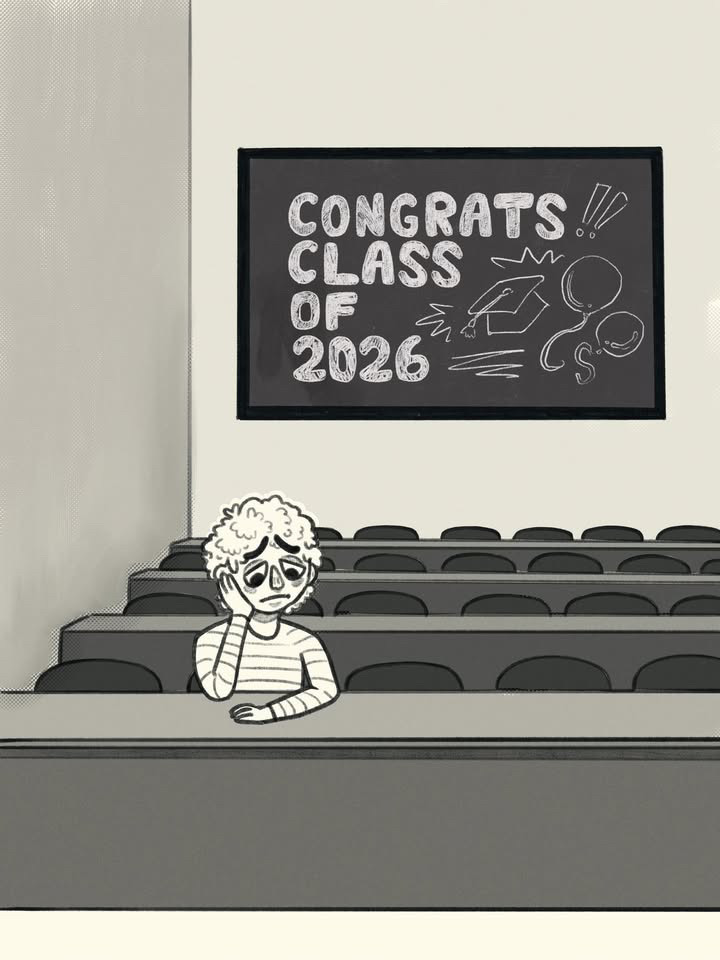
I view my fifth-year as a privilege. So, then why is pursuing one still shrouded in misunderstandings and taboo?
At an institution like U of T, pursuing a fifth-year should be more normalized.
Listen to the audio version of this article here!*
Since my first semester at UTM, I planned to complete a fifth year. Because of this firm decision, I experienced it all. The wide eyes, flared eyebrows, and concerned head tilts, followed by an inevitable “why?” The occasional monologue of well-intentioned advice that I sort of appreciated but never asked for: “so a few summer classes to catch up… petition to complete a course overload… I would just finish up my degree, and if I were you…”
I’m not alone in this. Whether it is peers, friends, colleagues, or family members, judgements about pursuing a fifth year can seem inescapable. But, for many students like myself, making the decision to pursue an additional year or semester beyond the “typical” four-year degree may prevent us from rushing into the next chapter of our lives with a lack of confidence—something that can impede our professional and personal journeys much more than taking an extra semester or year.
Statistics Canada reported that from 2015-2016, the average time to complete an undergraduate degree was 4.7 years. While the organization has yet to update their study’s findings, The New York Times also observed that most students do not complete their undergraduate degree in four years.
I believe that our time at university should be measured not by just what we learned in classrooms or through work, research, or internship experiences, but by the honest conversations and reflections we have with ourselves and our peers about who we are, what we need, and what we want at specific moments in time. If those conversations and desires don’t fit into dominant narratives of “success,” then maybe we should question the narrative as opposed to our own worth and success as students.
But, where do these preconceived judgements even come from? The notion that a four-year degree is and should be standard really originates from when societal pressures funnel individuals toward a linear trajectory of so-called success. This completely arbitrary trajectory claims that students must graduate from high school in four years, attain a four-year undergraduate degree, then enter the workforce or earn a master’s degree soon after.
Various biases also fuel these expectations. Underneath the concerned head tilts and invasive questions lies the assumption that students who complete a fifth-year are doing so to make up for poor marks, or that they must have struggled with keeping themselves academically afloat, or lacked valuable time-management skills, or had planned their courses poorly. Was I not organized and proactive enough to thrive in the fast-paced and competitive environment of U of T, and therefore had to waste a critical year that could have otherwise been leveraged toward more productive aims?
Instead of ruminating about alleged lost time, I believe that students must shift their perspective to recognize the benefits of a fifth-year. University can often feel like a homogenizing experience: we are all stuffed into similar classes, routines, and rituals to eventually arrive at a specific destination. Because of this, it’s easy to forget that each undergraduate journey and definition of success is different, defined by the unique combination of challenges, values, and goals that each one of us carry.
Part of the challenge of actually shifting taboos and uncertainties associated with a fifth-year and beyond is demystifying the opportunities that come with taking more time. Many students leverage their fifth-year to seek additional opportunities beyond the classroom. They may earn income through work, co-ops, or internships. Some volunteer or engage in co-curricular activities. Others apply for grants, bursaries, or scholarships.
These opportunities require ample time to not only complete but to even pursue in the first place. Students scour through virtual portals, discerning between authentic applications and ghost postings. They must network to fulfil the purportedly recommended but in actuality compulsory letter of recommendation. Of course, they must tailor their resumes and cover letters for each application, finding a sliver of time within their already bloated schedule to seek support from a career counselor.
Some students may take an extra year because of uncertainty with their program and academic future. For instance, I entered university unsure about what programs to pursue. I felt dizzied by the smorgasbord of possible minors, majors, and specialists, along with the optional certificates. Students may shift their programs of study, too. They may remove a program, based on the requirements. They might drop a course that threatens to shackle their CGPA. They may add another program, after an elective course sparks an unexpected passion. Some may even consider a different program half way through their degree due to uncertainty with how AI will impact their employment security.
I experimented with an arsenal of courses—hopping from law to linguistics, English to education studies, and politics to psychology. In my second year, I reapplied to my Program Of Study (POSt), confident in my choice: a major in sociology, a double minor in education studies and professional writing and communication, and a certificate in global studies. Yes, it’s a mouthful that absorbs precious space on my two-paged resume.
But, the greatest asset that an extra year offers isn’t just the additional time to simply keep hustling away; it’s the freedom to invest more resources and care into ourselves without feeling like our race to the finish line is being timed. Burnout, the glamourization of overworking, and mental health challenges are not things we expect to factor into our vision of university life; but here at U of T, those experiences can become inevitable realities for the many of us. If a fifth-year can ease some of those pressures, give students more time to connect with resources, and wrap up their degrees with more confidence and self-care, why do we continue to believe a four-year degree should be the norm?
Throughout university, I met students who completed their degree in three years, while others took seven years. I realized that students try to form the decision that feels right for them, while navigating various barriers and pressures. Some students cannot even consider a fifth-year—despite their desire—because of visa restrictions, financial barriers, and even hidden family pressures rooted in outdated cultural expectations
As I prepare to graduate this fall, I view my fifth year as a privilege. Even so, I don’t have a grand piece of advice to offer here. I only encourage students to reflect on what pathway feels right for them. One day, we will beam at the Starbuck’s sprints, dining hall dashes, and the looming fear of geese attacks. For now, focus on the moment: one assessment at a time, one week at a time. And, can we please stop the super senior jokes? I promise, it’s not that serious.
*AI-Generated Audio Transcription Disclaimer
The audio transcription included in this article was generated using artificial intelligence (AI) technology with the purpose of improving accessibility for our readers and providing an alternative opportunity to engage with The Medium‘s content. Please note that AI-generated transcriptions may contain errors or inaccuracies in pronunciation, wording, or interpretation.
The original written article remains the authoritative version of the content. If you notice an error in the audio transcription, please contact social@themedium.ca so we can for further reviews and corrections.