
One Sheet, Two Countries, and the Cost of Connection
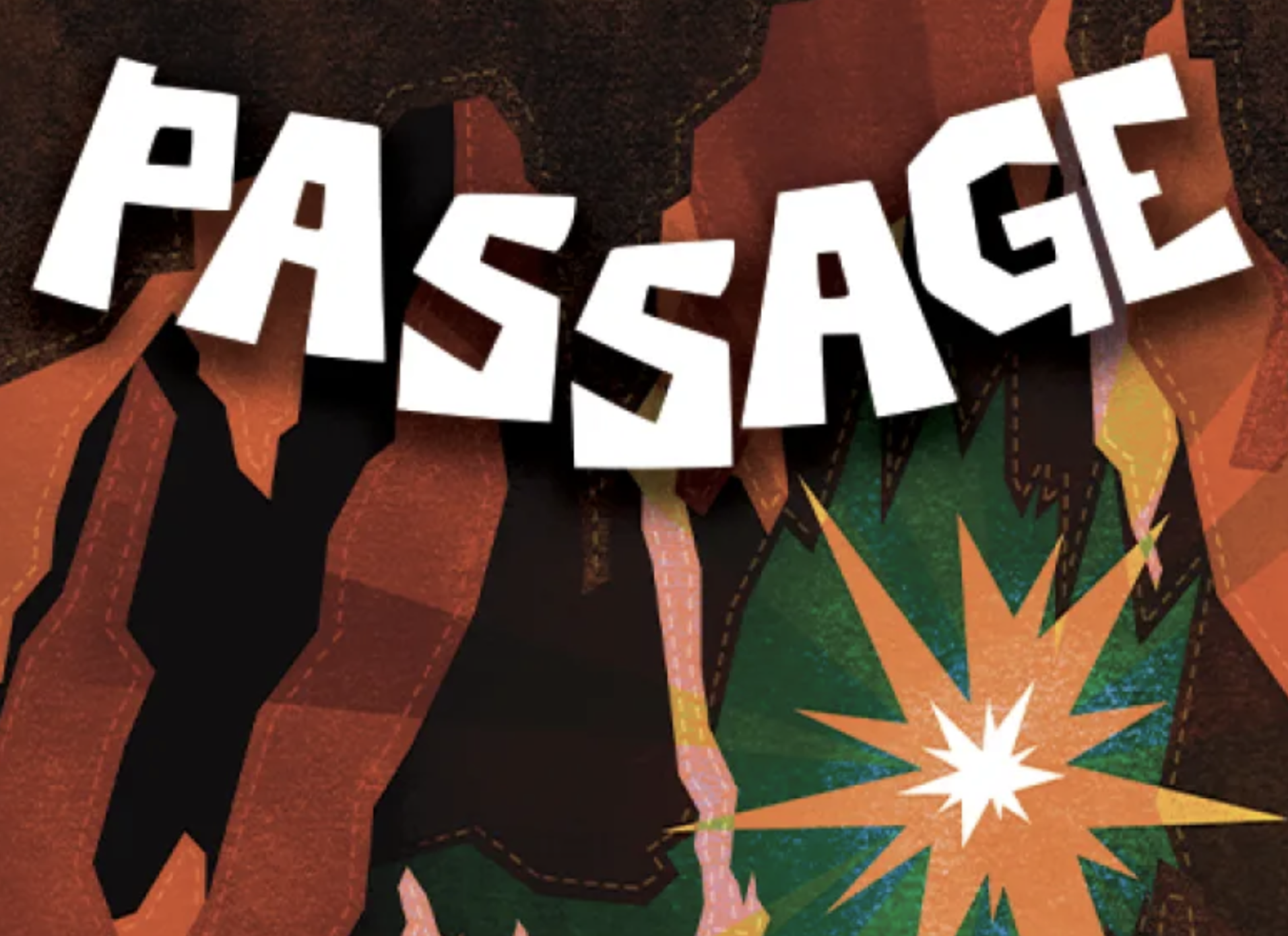
A review of Theatre Erindale’s first show of the season, The Passage.
Listen to the audio version of this article here!*
Christopher Chen’s The Passage, performed in the Erindale Studio Theatre at the University of Toronto Mississauga (UTM), follows characters from two fictional countries, X and Y, whose relationships are shaped by political conflict. The power that Country Y holds over Country X creates an imbalance that is shown in every interaction between their citizens. Through the characters’ attempts to understand one another, the play asks whether people can connect across a divide created by oppression.
The play opens with the entire cast introducing themselves and sharing where they come from, followed by a land acknowledgment confronting Canada’s history as stolen land. The actors then turn to the audience and ask where they’re from, encouraging them to reflect on the issues Country Y-ers and Country X-ers will soon encounter. This interactive opening makes the performance feel less like a distant story and more like a conversation.
One of the play’s central debates emerges through Country X-er, B, played by Ish Chawla, and her friends. They question whether it’s possible to be friends with someone from Country Y. If someone benefits from an unjust system, can they separate themselves from it? And should those harmed by that system be expected to look past it? These questions become increasingly complicated as the characters discover that good intentions do not necessarily erase historical injustice.
The production’s costume design reinforces the divide between the countries. Characters from Country X wear beiges, yellows, and other neutral tones, while those from Country Y wear darker reds and purples, colours that suggest wealth, status, and royalty. Costume designer Michelle Vanderheyden’s choices establish a visual distinction between the groups before the audience fully understands the divide between them.
The set, however, is where the production’s creativity truly shines. Rather than relying on elaborate scenery, the entire stage is built around a single large white sheet that covers the entire floor of the stage, and is lifted in certain areas by ropes. The ensemble lifts and manipulates sections of fabric to create temples, buildings, and caves. Sometimes the actors even enter the sheet itself, transforming it into an enclosed space. One particularly memorable moment occurs when Q (played by Arnav Narula) and his fiancée, R (played by Abby Wolfe), interact with a raised section of the sheet as though it were a stereo. The sheet becomes more than a backdrop: it is an active part of the performance, demonstrating how imagination and collaboration can transform something simple into an entire world.
The characters’ relationships are equally layered. A quieter moment amid the political tension is B’s monologue in a sacred template about childhood imagination and how exploring one’s universe can feel sacred. Later, F (Joana Louise), a Country Y citizen, enters the temple and removes her shoes after noticing that B has done the same. The two characters meet here for the first time and begin to form a friendship.
Louise brings an interesting uncertainty to F. She seems eager to understand B and prove that she is different from others from Country Y, but her desire for approval sometimes makes her appear more concerned with fitting in than fully understanding the issues she is discussing. In a monologue where she begins to talk to a mosquito on her coat hanger, F hears that the jungle does not understand walls, challenging the boundaries people create around themselves. Her confusion about where she belongs reflects a larger question: can someone reject their country’s attitudes while still benefiting from its power?
Meanwhile, Q’s relationship with R reveals another side of the conflict. R resists visiting local places and questions Q’s willingness to step outside his familiar world, even asking whether he is becoming “PC.” Their disagreement highlights the difference between Q’s curiosity and R’s reluctance to challenge her assumptions.
The political tension becomes more tangible when the characters discuss the brutal arrest of a young boy from Country X who stole a pack of batteries. People from Country X see the treatment as cruel and unjust, while those from Country Y argue that the arrest followed Country X’s own laws. The disagreement demonstrates how the same event can be interpreted differently depending on one’s perspective and relationship to power. The production reinforces this divide visually, too: characters from Country X often sit on cushions on the floor, while those from Country Y use chairs and tables.
The conflict reaches its breaking point when B, F, and Q decide to visit the caves. F feels sick and encourages B and Q to continue without her. While B pays attention to the environment, Q seems more concerned with whether B likes him. Although he remarks that Country Y differs from the stereotypes he expected, his attempts to connect with B remain complicated by the assumptions he carries with him.
Inside the cave, Q panics. When B approaches to help him, he becomes frightened and attempts to shoot her in his confusion. B is subsequently arrested after Q claims she tried to hurt him. Narula perfectly captures how quickly Q’s fear overwhelms his judgment. We see him enter the cave. We don’t get to see his face but only the fear and panic coming from his voice. The incident transforms the play’s debate about friendship into something much more serious: B now faces the consequences of an encounter shaped by fear, mistrust, and power imbalance.
After speaking with F, Q eventually admits what actually happened. However, his confession does not resolve the conflict. F wants B to drop the charges, but B questions why F did not intervene during her arrest. Given F’s privilege, B argues, she could have tried to stop what was happening. Yet the play also leaves room to question whether B’s expectations of F are realistic. F may have advantages that B does not, but that does not automatically mean she knows how to use them. Their disagreement reveals how even people who care about one another can have different ideas about what solidarity requires.
Chawla’s performance is particularly powerful in these confrontations. She brings intelligence, frustration, and vulnerability to B’s anger. Narula captures Q’s insecurity and misguided attempts at connection.. Louise makes F’s uncertainty and desire for acceptance believable.
Mikey De Carolis, who plays S, D, and the Gecko, demonstrates versatility by taking on multiple roles. Together, the cast handles the production’s shifts between political debate, emotional conversations, and surreal encounters with commitment. Their coordination is especially important to the constantly changing sheet-based set, which depends on the ensemble working together.
The professor’s final monologue, during the final scene, brings the play’s ideas together with the line, “The inability to connect is where the seeds of anger and violence begin.” Shriyanshi Quanoongo delivers this closing moment, leaving the audience with a powerful reminder that the inability to understand one another can allow prejudice and violence to grow.
Ultimately, The Passage does not suggest that friendship alone can erase oppression or repair the damage caused by history. Instead, it asks whether meaningful connection is possible when people occupy different positions within an unjust system and what responsibility comes with the privilege to reach across that divide.
Through its inventive set, thoughtful costume design, and compelling performances, the production leaves its audience with a question that extends beyond the theatre: is it enough to want to connect with someone, or must we first confront the inequalities that stand between us?
*AI-Generated Audio Transcription Disclaimer
The audio transcription included in this article was generated using artificial intelligence (AI) technology with the purpose of improving accessibility for our readers and providing an alternative opportunity to engage with The Medium‘s content. Please note that AI-generated transcriptions may contain errors or inaccuracies in pronunciation, wording, or interpretation.
The original written article remains the authoritative version of the content. If you notice an error in the audio transcription, please contact social@themedium.ca so we can conduct further reviews and corrections.